
UC Davis · Solar + Agriculture Research
Welcome to the UC Davis Agrivoltaics Research Site
A living laboratory comparing solar technologies and their influence on crops, water, soil, farm operations, and renewable energy generation.
A living laboratory
What does the future of farming look like? The UC Davis Agrivoltaics Research Site is a living laboratory where researchers compare multiple photovoltaic technologies to better understand how system design influences crop production, water use, soil health, farm operations, and renewable energy generation.
Agrivoltaics, a concept coined in the 1980s in Germany, combines agriculture and photovoltaics–the conversion of sunlight into electricity. The idea is based on demonstrating how crops and solar panels can work in partnership rather than compete for space. By combining both uses, agrivoltaic systems have the potential to increase land productivity and reduce onsite operational costs, while supporting food production, renewable energy generation, and environmental sustainability.
Researchers worldwide are studying how different solar technologies affect crop growth, water use, soil conditions, and farm operations. Early findings suggest that strategically managed shade can reduce water demand, protect from extreme heat, harmful hail storms and improve working conditions for farm laborers.
Because agrivoltaics encompasses many different solar technologies, no single system is optimal for every crop or farming operation. This research site allows multiple approaches to be evaluated side-by-side under the same growing conditions. Explore each demonstration outlined below to learn how each system contributes to the future of sustainable agriculture and renewable energy.
Comparative research
Four Agrivoltaic Systems, One Field
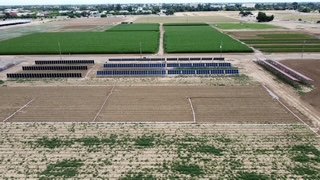
Unlike most agrivoltaic research sites, this installation contains various technologies; including four distinct solar racking systems, and bifacial and spectrum selective modules within a single field. Together, the systems provide a unique opportunity to compare energy production, crop response, farm equipment access, and overall land-use efficiency.
Completed and connected to the grid in June, 2026, the site consists of 448 photovoltaic modules with a combined capacity of 200.44 kW DC. The electricity generated from the demonstration site will be used to power the UC Davis campus.
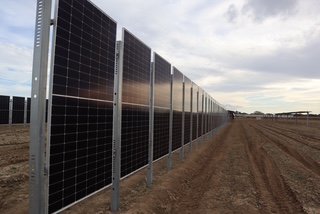
Vertical Bifacial System
- RackingSunzaun
- ModulesLESSO 585 W Bifacial
- InvertersCPS America 50 kW, 1000 V
Vertically mounted bifacial modules generate electricity from both east- and west-facing surfaces, capturing morning and afternoon sunlight. The design provides uniform shading patterns, excellent access for equipment, and strong compatibility with agricultural operations.
Researchers are evaluating how vertical solar configurations affect crop growth, field operations, and energy production while maintaining productive agricultural land.
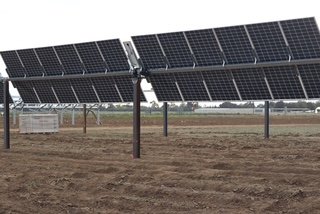
Single-Axis Tracker
- RackingNextPower Horizon Tracker (by Ampacity)
- ModulesThornova 545 W Bifacial
- InvertersCPS America 50 kW, 1000 V
The NX Horizon tracker follows the sun throughout the day, maximizing energy generation by continuously adjusting module orientation. As one of the most widely deployed tracker systems in the world, it serves as an important benchmark for agrivoltaic performance.
This installation allows researchers to study how a conventional utility-scale tracker impacts crop conditions, field access, and overall land-use efficiency.
Single-Axis Tracker
- RackingNevados TRACE™ All Terrain Tracker
- ModulesTalesun Solar 545 W Bifacial
- InvertersCPS America 50 kW, 1000 V Inverter
The Nevados TRACE tracker is designed to operate on uneven terrain while minimizing site grading requirements. The system incorporates terrain-aware tracking controls that allow modules to follow the sun while adapting to natural site conditions.
Researchers are comparing its performance against other tracker technologies while evaluating how terrain-adaptive designs may support agricultural operations and reduce site development impacts.
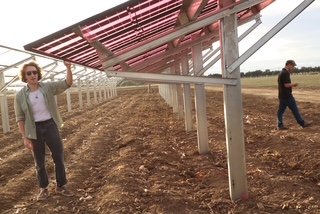
Fixed-Tilt System with Spectral Selective Modules
- RackingOMCO Solar, Choice Fixed Tilt
- ModulesConstructive Systems 290 W, Red Spectrum Selective
- InvertersCPS America 50 kW, 1000 V
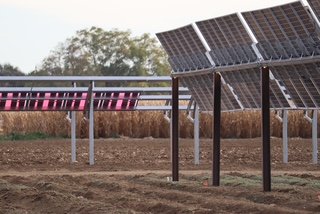
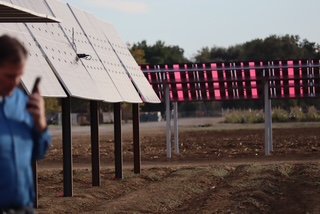
This fixed-tilt installation features spectrally selective photovoltaic modules designed to transmit portions of the light spectrum that are important for plant growth while generating renewable electricity. The distinctive red-colored modules create a unique growing environment that differs from conventional solar installations.
Because plants respond differently to specific wavelengths of light, researchers are investigating whether selectively filtering sunlight can improve crop growth and water use while continuing to generate renewable electricity. Comparing this system with the other agrivoltaic technologies on site will help determine how spectral management influences both agricultural and energy performance.
A controlled comparison
Shared Technology
All four arrays utilize CPS America 50 kW inverters to convert the electricity generated by the solar modules into grid-compatible power. Using a common inverter platform enables researchers to compare the effects of different module and racking technologies while minimizing differences attributable to the power electronics.
Together, the four systems represent a diverse cross-section of agrivoltaic approaches, providing farmers, researchers, and policymakers with valuable insights into how varying solar technologies can be integrated into commercial agricultural landscapes.
Built around agricultural work
Designed for Farming
A defining feature of the installation is its approximately 50-foot row spacing, intentionally designed to accommodate commercial-scale farming equipment. Designing around real agricultural operations ensures that agrivoltaic systems can support farming rather than interfere with it.
Over the coming seasons, researchers will study tomatoes and other crops growing between the solar rows while monitoring crop yields, soil moisture, microclimate conditions, carbon sequestration, and overall farm compatibility.
By comparing multiple agrivoltaic technologies in a working agricultural environment, the UC Davis research facility will generate long-term data to help guide the future design of farming systems. These findings will help inform researchers, policymakers, farmers, and industry leaders as they shape the future of sustainable food and renewable energy production.
Project delivery
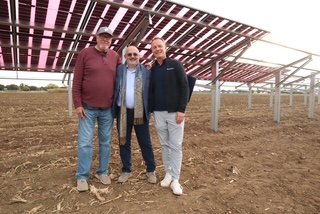
Sunlight Energy served as the EPC contractor for this demonstration site in Davis, Northern California, coordinating suppliers and overseeing construction of the research facility.
Based in Yuba City, Sunlight Energy serves Northern California farms and businesses with solar design, engineering and construction. Explore our agricultural and commercial solar services or discuss your solar project with our team.